Rosy Barb — Tank Size, Adult Size, Lifespan & Full Care Guide
Pethia conchonius
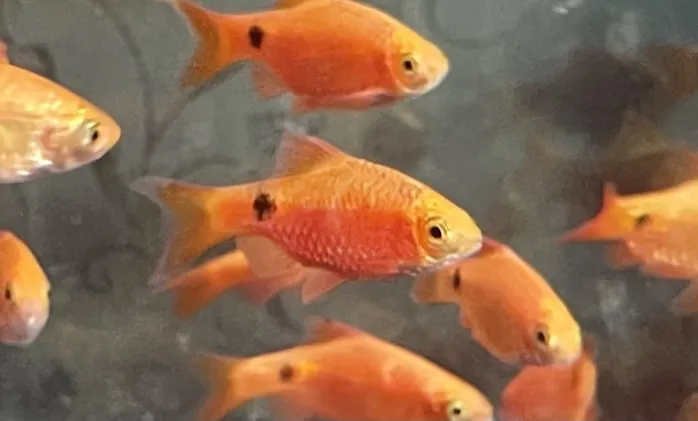

Care requirements at a glance
| Scientific name | Pethia conchonius |
|---|---|
| Group | Barb |
| Adult size | 4.0 in (10.0 cm) |
| Minimum tank | 29 gallons |
| Temperature | 64-75°F |
| pH | 6-8 |
| Hardness | 5-19 dGH |
| Temperament | Peaceful |
| Social | Schooling (keep 6+) |
| Diet | Omnivore |
| Swim level | Mid |
| Care level | Easy |
| Lifespan | ~5 years |
How big do Rosy Barb get? Adult size explained
Adult rosy barb reach 4.0 inches (10.0 cm). Fish you buy are almost always juveniles at roughly 1.5″, so plan the tank around the adult number, never the size in the bag.
| Stage | Typical length |
|---|---|
| Size sold in stores | about 1.5″ |
| Half-grown | 2.8″ at roughly 6 months |
| Full adult size | 4.0″ (10.0 cm) by 12 months |
Rosy Barb tank size: minimum vs recommended
The 29-gallon figure is a floor, not a target. It assumes a cycled, filtered tank and an owner who does weekly water changes. Rosy Barb need at least 6 individuals, so the real question is not "will one fit" but "will 6 of them fit".
Numbers assume rosy barb are the main occupants with light additional stocking. Use the stocking calculator to model a mixed community.
Rosy Barb group size
Rosy Barb are a shoaling species. In groups below 6 they show measurable stress behaviour: faded colour, hiding and skittishness. Minimum: 6. Better: 8–12. If your budget forces a choice between more species and bigger groups, always choose bigger groups.
Rosy Barb water parameters
| Parameter | Range | Notes |
|---|---|---|
| Temperature | 64–75°F | keep it stable; no heater needed at normal room temperature — this species prefers cooler water. |
| pH | 6–8 | stability beats the exact number |
| Hardness (GH) | 5–19 dGH | |
| Ammonia (NH₃) | 0 ppm | any reading means the tank is not cycled |
| Nitrite (NO₂) | 0 ppm | any reading is an emergency — water change now |
| Nitrate (NO₃) | under 20–40 ppm | controlled by water changes and live plants |
What do Rosy Barb eat? Diet and feeding
Unfussy omnivores. Quality flake or pellet as a staple, with frozen or live food twice a week. They also nibble soft plants when underfed on vegetables.
The single most common feeding error is quantity, not quality. Feed what disappears in about two minutes, once or twice a day, and the tank stays clean.
How long do Rosy Barb live?
Rosy Barb tank mates: what works and what does not
Compatibility is decided by four things, in this order: water parameters (64–75°F, pH 6–8), adult size, temperament, and swimming level.
Good tank mates
Avoid these
Check any pairing in the compatibility tool →
Breeding Rosy Barb
Easy egg-scatterers. Condition the group on live food, spawn over marbles or moss in the morning sun, then remove the adults — they eat their own eggs.
Male vs female rosy barb
Easy to sex: males are the pink ones and intensify at breeding time; females are rounder with a golden-olive tone.
Rosy Barb health, diseases and prevention
Prevention beats treatment every time: quarantine new arrivals for two weeks, keep the tank understocked rather than at maximum capacity, and do a consistent weekly water change.
What does a rosy barb setup cost?
| Item | Typical cost |
|---|---|
| Aquarium, 29 gal | $90 |
| Filter | $30 |
| Light | $28 |
| Substrate & decor | $30 |
| Liquid test kit | $32 |
| 6× rosy barb | $30 |
| Estimated total | $240 |
Indicative US retail prices for a new setup.
Rosy Barb FAQ
What size tank do rosy barb need?
The minimum tank size for rosy barb is 29 gallons. Because they need a group of at least 6, we recommend 40 gallons or larger for a healthy long-term setup.
How big do rosy barb get?
Adult rosy barb reach 4.0 inches (10.0 cm). Store specimens are usually juveniles at around 1.5 inches, so always plan the tank around the adult size.
How long do rosy barb live?
Rosy Barb typically live about 5 years in a well-maintained aquarium. Stable water quality and a varied diet are the two biggest factors in reaching the upper end of that range.
How many rosy barb should I keep together?
Keep at least 6 together. Groups of 8 to 12 show noticeably better colour and more natural behaviour. Below 6 they become stressed, hide and lose colour.
What water parameters do rosy barb need?
Keep rosy barb at 64–75°F, pH 6–8, and hardness 5–19 dGH. Ammonia and nitrite must both read zero at all times.
Are rosy barb good for beginners?
Rosy Barb are rated easy. They are a solid choice for a first community tank as long as the tank is cycled first.
What do rosy barb eat?
Unfussy omnivores. Quality flake or pellet as a staple, with frozen or live food twice a week. They also nibble soft plants when underfed on vegetables.
Do rosy barb need a heater?
Usually not. Rosy Barb are comfortable at 64–75°F, which includes normal room temperature — one of the few popular species happy in an unheated tank.
What fish can live with rosy barb?
Good tank mates include Zebra Danio, White Cloud Minnow, Cherry Barb, Bronze Corydoras, Platy, Swordtail. Match water parameters first, then temperament, then adult size.
What should you not keep with rosy barb?
Avoid Betta, Dwarf Gourami, Discus. These are either aggressive towards them, unsafe around them, or need water parameters too far outside 64–75°F and pH 6–8.