Panda Corydoras — Tank Size, Adult Size, Lifespan & Full Care Guide
Corydoras panda
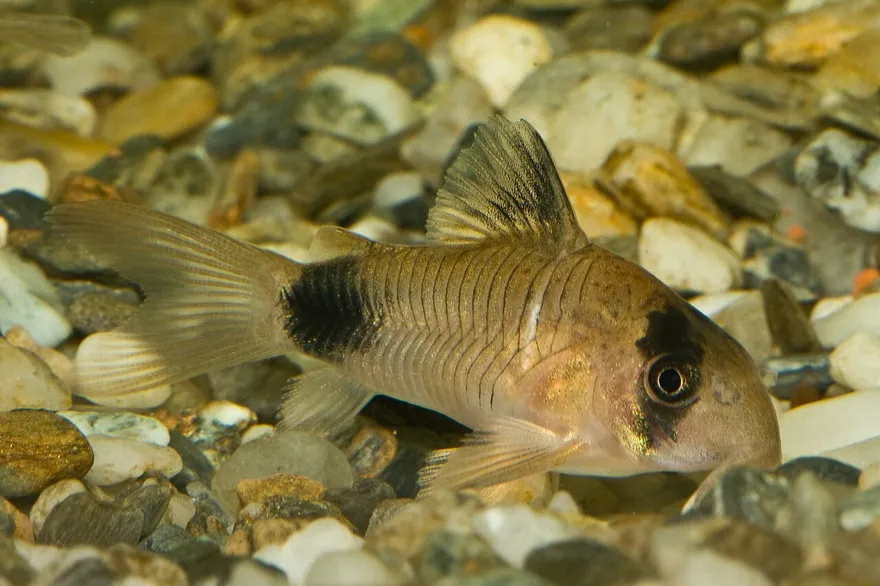

Care requirements at a glance
| Scientific name | Corydoras panda |
|---|---|
| Group | Catfish |
| Adult size | 2 in (5.1 cm) |
| Minimum tank | 20 gallons |
| Temperature | 68-77°F |
| pH | 6-7.2 |
| Hardness | 2-12 dGH |
| Temperament | Peaceful |
| Social | Schooling (keep 6+) |
| Diet | Omnivore |
| Swim level | Bottom |
| Care level | Moderate |
| Lifespan | ~10 years |
How big do Panda Corydoras get? Adult size explained
Panda Corydoras sit in the classic community-fish size band. They are big enough to be visible from across a room, small enough that a standard 20-gallon tank gives them real swimming space. Adult panda corydoras reach 2.0 inches (5.1 cm). Fish you buy are almost always juveniles at roughly 0.9″, so plan the tank around the adult number, never the size in the bag.
| Stage | Typical length |
|---|---|
| Size sold in stores | about 0.9″ (2.3 cm) |
| Half-grown | 1.5″ (3.8 cm) at roughly 6 months |
| Full adult size | 2.0″ (5.1 cm) by 10 months |
| Sexual maturity | usually before full size, around 4–6 months |
Growth rate depends mostly on feeding quality and water changes in the first six months. Stunted growth from poor water does not make the fish 'stay small' safely — internal organs keep growing, which shortens lifespan considerably.
Panda Corydoras tank size: minimum vs recommended
The 20-gallon figure is a floor, not a target. It assumes a cycled, filtered, planted tank and an owner who does weekly water changes.
Remember that the minimum tank and the minimum group interact. Panda Corydoras need at least 6 individuals, so the real question is not “will one fit in 20 gallons” but “will 6 of them fit”. That is why we recommend 40 gallons as the practical starting point.
| Tank size | Panda Corydoras it supports | Verdict |
|---|---|---|
| 5 gallons | — | Too small |
| 10 gallons | — | Too small |
| 20 gallons | 8 in one group | Workable minimum |
| 29 gallons | 12 in one group | Workable minimum |
| 40 gallons | 17 in one group | Comfortable |
| 55 gallons | 18 in one group | Comfortable |
| 75 gallons | 18 in one group | Comfortable |
Numbers assume panda corydoras are the main occupants with light additional stocking, a filter rated for the tank, and weekly 25–30% water changes. Use the stocking calculator to model a mixed community.
Panda Corydoras group size: how many should you keep together?
Panda Corydoras are a shoaling species. In groups below 6 they show measurable stress behaviour: faded colour, hiding, refusing food and darting at the glass. This is not a preference — it is how the species regulates its own sense of safety.
Minimum: 6. Better: 8–12. Colour and natural behaviour improve noticeably once the group passes about 10. If your budget forces a choice between more species and bigger groups, always choose bigger groups — a tank with two well-sized shoals looks far better than one with six lonely singletons.
Panda Corydoras water parameters
| Parameter | Range | Notes |
|---|---|---|
| Temperature | 68–77°F (20–25°C) | aim for 72°F and keep it stable |
| pH | 6–7.2 | target 6.6; stability beats the exact number |
| Hardness (GH) | 2–12 dGH | soft to moderate |
| Ammonia (NH₃) | 0 ppm | any reading means the tank is not cycled |
| Nitrite (NO₂) | 0 ppm | any reading is an emergency — water change now |
| Nitrate (NO₃) | under 20–40 ppm | controlled by water changes and live plants |
This is a soft-water species. If your tap runs above about 12 dGH you will do better with a different fish than with constant chemical adjustment — chasing parameters causes more deaths than the wrong parameters do.
Stability matters more than perfection. A tank sitting steadily at pH 7.4 is healthier than one swinging between 6 and 7.2 every week. Test your tap water first, then choose fish that match it, rather than buying the fish and fighting the water afterwards.
Ideal panda corydoras tank setup
Prefer slightly cooler water (68-77°F) than most corys. A 20-gallon tank with a group of 6+ and peaceful tankmates. Provide sand substrate, hiding spots, and gentle flow.
| Substrate | Fine sand or smooth gravel. Sharp gravel damages barbels. |
|---|---|
| Planting | Heavily planted with broad leaves and moss. Plants are not decoration for this species — they are cover, grazing surface and a stress buffer. |
| Flow | Gentle. Baffle the filter outflow if the fish are being pushed around. |
| Lighting | Moderate. Floating plants diffuse the light and make shy fish bolder. |
| Lid | Recommended — it also reduces evaporation and heat loss. |
What do Panda Corydoras eat? Diet and feeding
Similar to bronze corys — sinking pellets, wafers, and frozen foods. Feed 1-2 times daily. Ensure food reaches the bottom. They are shy feeders initially.
The single most common feeding error is quantity, not quality. Panda Corydoras have a stomach roughly the size of their eye. Feed what disappears in about two minutes, once a day, and the tank stays clean.
Staple: quality flake or micro-pellet as the staple.
- Frozen daphnia or brine shrimp twice a week
- Blanched vegetable matter once a week
- Occasional live food for conditioning
| Frequency | What to do |
|---|---|
| Daily | One small feeding of quality flake or micro-pellet as the staple. Everything eaten within 2 minutes. |
| 2–3× weekly | Rotate in a second food type for variety and micronutrients. |
| Weekly | One fasting day gives the gut time to clear. Skip this for fry and for shrimp. |
Panda Corydoras behaviour and temperament
Panda Corydoras are peaceful and will not start trouble. Their weakness is the opposite — they are easily bullied or outcompeted for food by faster or bolder species. They spend most of their time in the substrate and lower third.
Signs of a settled, healthy specimen: strong colour, fins held open, active foraging, and a normal reaction to your hand near the glass. Signs of a stressed one: clamped fins, faded colour, hovering in a corner, gasping at the surface, or hiding constantly during daylight hours.
How long do Panda Corydoras live?
| Factor | Effect on lifespan |
|---|---|
| Stable, cycled water | Adds years. The most common cause of early death in panda corydoras is ammonia exposure in an uncycled tank. |
| Correct temperature | Running warmer than 77°F speeds metabolism and shortens life; running cold invites disease. |
| Varied diet | Single-food diets cause organ problems and colour loss over time. |
| Right group size | Chronic stress from wrong social setup measurably shortens lifespan. |
| Genetics | Mass-bred stock from large farms often lives noticeably shorter than quality or local stock. |
Panda Corydoras tank mates: what works and what does not
Compatibility is decided by four things, in this order: water parameters (68–77°F, pH 6–7.2), adult size, temperament, and swimming level. A fish that matches on three and fails on one is not a match.
Good tank mates
Avoid these
Check any pairing in the compatibility tool →
Breeding panda corydoras
Egg-depositors. More difficult to breed than bronze corys. Trigger with cool water changes and increased flow. Eggs hatch in 3-5 days. Fry need small foods.
If you want fry to survive, the practical route is a separate, gently filtered grow-out tank. In a community tank almost every egg or fry becomes food, which is normal and not a sign that anything is wrong.
Male vs female panda corydoras
Males are smaller (1.5") and slimmer. Females are larger (2") and rounder. Females have a more rounded body shape when viewed from above.
Panda Corydoras health, diseases and prevention
| Problem | What you see | What to do |
|---|---|---|
| Ich (white spot) | Salt-grain white dots, flicking against decor | Raise temperature slowly to 82°F and treat; aquarium salt is usually tolerated. |
| Fin rot | Ragged, receding or blackened fin edges | Almost always water quality. Increase water changes before reaching for medication. |
| Bloat / constipation | Swollen belly, stringy white waste | Fast 2–3 days, then feed blanched deshelled pea or daphnia. |
| Bacterial infection | Red streaks, ulcers, lethargy | Quarantine and treat with a broad-spectrum antibacterial; review water quality. |
| Stress / chronic hiding | Faded colour, clamped fins | Check parameters, group size and tank mates before medicating. |
Prevention beats treatment every time: quarantine new arrivals for two weeks, keep the tank understocked rather than at maximum capacity, and do a consistent weekly water change instead of a large emergency one every month.
First 30 days with Panda Corydoras: a practical checklist
Most losses happen in the first month, and almost all of them are avoidable. This is the schedule we recommend.
| Before you buy | Do not add fish yet. The tank must be fully cycled: ammonia 0, nitrite 0, nitrate present. A cycled tank is the single biggest predictor of whether these animals survive. |
|---|---|
| Day 1 — acclimation | Float the bag 20 minutes to match temperature, then drip acclimate over 45–60 minutes. Never pour store water into your tank. |
| Days 1–3 | Lights off or dimmed. Do not feed on day one. Expect hiding and pale colour; this is normal. |
| Days 4–14 | Test ammonia and nitrite every second day — new stock is the classic trigger of a mini-cycle. Feed lightly. Watch that every individual is eating. |
| Days 14–30 | Colour should be full and behaviour settled. This is the window where ich typically shows up — check body condition from above, not just from the side. |
| After day 30 | Now you can add the next species. Adding stock in stages rather than all at once is what keeps the filter ahead of the bioload. |
Common mistakes when keeping Panda Corydoras
- Buying 3 instead of 6 — The most common mistake with this species. An under-sized group is a permanently stressed group, and stress is what makes fish susceptible to everything else.
- Adding stock to an uncycled tank — Ammonia burns gills permanently. Cycle first, always — see our tank cycling guide.
- Overfeeding — Uneaten food becomes ammonia. Two minutes, once a day is the rule.
- Chasing pH with chemicals — pH adjusters cause swings that are far more dangerous than a stable pH slightly outside 6–7.2.
- Skipping quarantine — Two weeks in a separate tank prevents most disease outbreaks in an established display tank.
What does a panda corydoras setup cost?
| Item | Typical cost |
|---|---|
| Aquarium, 40 gal | $108 |
| Filter | $45 |
| Light | $55 |
| Substrate & decor | $46 |
| Liquid test kit | $32 |
| 6× panda corydoras | $48 |
| Estimated total | $334 |
Indicative US retail prices for a new setup. Running cost is modest: mostly electricity for the filter, plus food and a water conditioner. Buying a larger tank up front is almost always cheaper than upgrading twice.
Panda Corydoras compatibility: verdict per tank mate
Each pair below is a full comparison of temperature, pH, adult size and temperament. Green means compatible, amber means workable with conditions, red means avoid.
Open the full compatibility matrix
Panda Corydoras FAQ
What size tank do panda corydoras need?
The minimum tank size for panda corydoras is 20 gallons (75 litres). Because they need a group of at least 6, we recommend 40 gallons or larger for a healthy long-term setup.
How big do panda corydoras get?
Adult panda corydoras reach 2.0 inches (5.1 cm). Store specimens are usually juveniles at around 0.9 inches, so always plan the tank around the adult size.
How long do panda corydoras live?
Panda Corydoras typically live about 10 years in a well-maintained aquarium. Stable water quality and a varied diet are the two biggest factors in reaching the upper end of that range.
How many panda corydoras should I keep together?
Keep at least 6 together. Groups of 8 to 12 show noticeably better colour and more natural behaviour. Below 6 they become stressed, hide and lose colour.
What water parameters do panda corydoras need?
Keep panda corydoras at 68–77°F (20–25°C), pH 6–7.2, and hardness 2–12 dGH. Ammonia and nitrite must both read zero at all times.
Are panda corydoras good for beginners?
Panda Corydoras are rated moderate. They are manageable for a careful beginner, but they need a stable, fully cycled tank and consistent maintenance — not a first-week purchase.
What do panda corydoras eat?
Similar to bronze corys — sinking pellets, wafers, and frozen foods. Feed 1-2 times daily. Ensure food reaches the bottom. They are shy feeders initially.
Do panda corydoras need a heater?
No. Panda Corydoras tolerate temperatures down to 68°F and can be kept at room temperature in most homes, which makes them one of the few genuinely unheated-tank species.
Do panda corydoras need a filter?
Yes. A filter houses the bacteria that convert ammonia to nitrate. Choose a filter rated for your tank volume; these fish come from slow water, so baffle a strong outflow.
Can panda corydoras live alone?
They can survive alone but should not be kept that way. Panda Corydoras are a shoaling species and a lone individual is a chronically stressed one, which shortens its life.
What fish can live with panda corydoras?
Good tank mates include Neon Tetra, Cardinal Tetra, Guppy, Endler's Livebearer, Platy, Swordtail. Match water parameters first, then temperament, then adult size — anything that can fit them in its mouth eventually will.
What should you not keep with panda corydoras?
Avoid Discus, German Blue Ram. These are either large enough to eat them, aggressive enough to harass them, or need water parameters too far outside 68–77°F and pH 6–7.2.
Are panda corydoras aggressive?
No. Panda Corydoras are peaceful and will not harass other fish. The risk runs the other way — they are easily bullied or outcompeted for food.
How do you tell male from female panda corydoras?
Males are smaller (1.5") and slimmer. Females are larger (2") and rounder. Females have a more rounded body shape when viewed from above.
Do panda corydoras breed in a home aquarium?
Egg-depositors. More difficult to breed than bronze corys. Trigger with cool water changes and increased flow. Eggs hatch in 3-5 days. Fry need small foods.
Why are my panda corydoras hiding or losing colour?
In order of likelihood: the tank is not fully cycled (test ammonia and nitrite), the group is too small, the temperature is unstable, or a tank mate is harassing them. Fading colour is the earliest visible stress signal in this species — test the water before treating for anything.
How much does a panda corydoras setup cost?
Expect roughly $334 for a complete new 40-gallon setup including tank, filter, light, substrate, a test kit and the animals themselves. Buying the right size once is cheaper than upgrading twice.